Friday, July 18, 2008

Historic milestone for geologists in Malaysia

It has been confirmed!

16/7/08, Wednesday at 11.43am.

That the much and long awaited bill has been passed in the Parliament... Geologist Bill 2008. Indeed this is a significant event for fellow geologists in the country, particularly those who are involved in jobs 'on-land', e.g. engineering geologist, site geologist etc.

Without the bill, geologists play second fiddle to engineers in the country, particularly those in the engineering field. Eh... who knows the ground better ar... engineer or geologist? Of course geologist la! Duh! How can someone (non-geologist) sign or certify a report that is prepared by geologist? And why geological input are put aside as far as anything on the ground is concerned? Imagine this: Moderately to highly weathered argillite ROCK (undergoing physical and chemical weathering, degrade and decompose over time), but when drilled into and sampled, it is described as sandy SILT (can't say clayey SILT according to BS 5930 konon). Hoho... that's a huge mistake... 'rock mass' now being classified as 'hard soil' (N=50). Another example: Drilled 3m into rock and borehole terminated, because one would think the rock is actually 'bedrock' ('continuous' laterally), but in actual fact, the rock is actually a huge boulder sitting on residual soil and the actual bedrock is 10m deeper. But because geological input is 'missing', piling was executed and terminated at the boulder level, but strangely, pile lengths are too short at some points.... why? Wrong interpreted 'bedrock' depth lar! So, the project cost will balloon up and based on the current price of steel bars, the profit margin of the project may be lost even before its completion!

Some people never learned. Even tragedies like landslides that caused the lost of lives and properties can't seem to change the mindset of policy makers or some engineers that some geological input would have stopped these tragedies from happening. A good example I can think of right now is the rockfall at Bukit Lanjan. Although I don't recall someone being killed in the rockfall event, I did remember the hardships (super traffic jams) that the road (or rather highway) closure that had caused.... affecting thousand of motorists on daily basis for more than half a year. A simple rock slope stability after the blasting of the rock slopes could have stopped this rockfall from occurring. A daylighting joint that provides the sliding plane for the blocky rocks could have identified and mitigating measures such as removing the 'loose' blocks of rocks could have been carried out.... and surely the rockfall incident could have been avoided. But I wonder whose money was spent on cleaning up on the mess there? I hope it is not the tax payers' monies. An act of God konon... very irresponsible statement by the minister when asked about the likely cause(s) of the rockfall.

Sinkholes. Settlement. Subsidence. Is your area affected by these? If the answer is yes, your place could have been:
i) a mining area in the past (mining going below ground surface)
ii) a soft ground being backfilled and insufficiently compacted or lack of foundation works
iii) an area that is underlain by karstic limestone (meaning some cavities or voids within the limestone)

Frankly speaking, I'm not a super expert. But if you see significant signs that like any of the above, best is to contact the geological survey department to find out the 'history' of the land. So before you buy a land, why not ask the advice of geologist first before committing yourself to sign the sales and purchase agreement? He/She could have save you lots of money repairing the possible defects on your property... but how to monetize the run-around and time lost in the getting the repair being carried out or identifying the real problem? And peace of mind? That's priceless....

So why not learn more about the profession and let us contribute something to the society in return? But please, we are just humans and we can't see 'through' the ground or hills okay... if we can do that, we would have been super rich, being able to locate primary tin, gold or economical ores/deposits in the subsurface!!!

And being a young chap like me that holds two professional affiliations at one time is not very common eh.... so must salute me when you see me... hehehehe.... just joking here ok.

Anyway... boss, if you are reading this, I need a pay rise. I'm not greedy lar... 50% increase pun jadi lar ... this is to keep myself from being caught up in the high cost of living due the ballooning inflation rate that is predicted to go over 8% this year...


Remediated cut slope (with retaining wall) somewhere along the 'new' east-west highway... between Karak and Kuantan. Judging by the shape of the failure, it looks like a circular landslip. But who cares? Cut the slope and repair later wat... toll payers' are paying for the repair, the contractor and engineers will be laughing all the way to the bank...

Sunday, July 13, 2008

Bug reporter for hire!

If you are a software developer and you would like to collate feedbacks about potential bugs (bug reporting) or gather constructive comments on how to improve certain aspects of your new applications, do drop me an email at tkurus@gmail.com.

I've always like to explore new software/applications.... and some of the ones that I'm familiar with are, but not limited to:
RESIX Plus, AGI EarthImager 2D, RES2DINV, FIRSTPIX, REFRACTION, Aarhus Workbench, Visual MODFLOW, Surfer & Rockworks.

There are more applications in addition to the above, but these are the ones that I am most familiar with. I would say most of them are related to 'geoscience' and 'modelling'.

Why me?

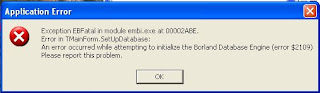
I have strong analytical skills, with some background in programming. It is usual the case where I've always try to 'push' new applications to its limits.... forcing it to produce bugs/errors such as these:


More bugs discovery meaning less complaints from potential clients/users. So why not try me out today?

Friday, July 4, 2008

Geophysical training programme

Participated in a geophysical training programme since last Monday, courtesy of Danida. We had a visiting professor from Aarhus Universitet of Denmark to share Denmark's technology and knowledge in multi-electrode profilling (resistivity survey). We managed to carry out 4 resistivity profiles, with an accumulated distance of 1.7km over 2 locations. The first location is within a prominent golf course in Kuala Lumpur territory, and the second, on a vacant land somewhere in Lembah Beringin (exact location is not disclosed, don't want to get sued).


This week's training module is a follow-up training that we first had in Denmark, back in March this year. Being exposed to 2D resistivity in the past, this training module is more like an affirmation for me, because I've already have had some basics back in uni days and extensive experience using this technique for groundwater exploration in Perak . But this training module is an added knowledge to me because a relatively new array, i.e. gradient array is being adopted for the acquisition of field resisitivity data. Apparently this array is a rojak between dipole-dipole, Wenner, Schlumberger etc. arrays, and widely used in Denmark for subsurface imaging. But I've always pondered if this widely used array in Denmark can be successfully applied here, on our terrain. The reason being is, in Denmark, the land is generally flat and underlain predominantly by sediments. And here on our terrain the geology is a complex one, we have all sorts of rock and formations - igneous, sedimentary and metamorphic rocks, you name it. And there is also limited papers describing the usage of the gradient array on tropical land like Malaysia, where we experience more vigorous weathering.

I was wrong eh... the signal over noise ratio for gradient array was so impressive that a profile conducted profile over electrical cables doesn't seemed to be affected that much and there weren't many negative readings as compared to other array that I've used before, e.g. pole-dipole (forward or reverse) and dipole-dipole. And looking at the pseudosection derived from the gradient arrangement, I think this array is the best to apply when you're carrying out a resistivity survey. But the downside is, over a profile of 400m long, the depth of penetration that you can expect is between 40-60m below ground surface, which is kind of shallow for 'our' standard. A quick look at the pseudosection that I've generated using the data acquired in Perak last year indicate that penetration depths were generally greater, whereby for pole-dipole and dipole-dipole arrays, the penetration depths are generally 90-100m and 50-70m, respectively.
But anyway, it's an eye opener for everybody because this is one rare opportunity where we actually have had a visiting professor from Denmark to teach us and share his knowledge on resistivity survey.

Wednesday, July 2, 2008

Working in Brunei

8 - 11/8/06

Site 1


This was the first ever site that I've worked on in Brunei Darussalam. Pretty interesting site where soil, sediment, groundwater and surface water are required to be sampled. And this was my first site that I had actually used a Van Dorn sampler for surface water sampling, and improvised a method for sampling soft sediments at the bottom of a pond. Completed all soil/sediment/gw/sw samplings with the help of colleagues in the record time... of three working days!! But it was pretty scary on the boat when we were carrying out the sw sampling and sediment sampling since we can't see the bottom and the overgrown underwater weeds keep 'grabbing' our equipments that were lowered down into the pond for probing/measurements.

Well, for the samplings within the pond area, the initial idea was to build platforms to 'reach' out to the sampling points.... but then again it will be very expensive (materials priced in BND) and building 4 or 5 platforms will be too time consuming. And we are a bunch of environmental sampling experts and not foundation engineers, where we need to calculate the proper strength of the materials and structure (platform) before we could actually put our weight on it. And then there was also an idea to build a pontoon... but then again, it won't be as stable as a boat. So since I am the de facto project manager of this site (and my colleague chose to be in charge over the 2nd site), we decided to go on a boat with peddlers, to carry out the sediment and sw sampling. For the sediment sampling, we tried using Ekman grab/dredge/bucket, but the soft sediments 'disappears' before we could lift the sampler out from the surface of the pond, and that warrants for plan B. But what's the plan B? No such plan.... heck... so in the first day of sediment sampling, we failed to retrieve sufficient sample... not even in decent volumes to fit into a single soil jar!

Pondered hard overnight over the predicament (sediment sampling), and suddenly the sampling mechanism of 'geotube' and obtaining undisturbed sample via Mazier sampling (from experience working at KL Pavillion site for 6 over months) came into the picture and voila... I took my chances and ordered 4-5 nos of 3m lengths of 1.5" dia uPVC pipe the following day, got on the boat, used a handheld GPS to get to the sampling points, whacked the short uPVC into the sediment 'beds', cap them (liken to close the tip of a straw to retain the liquid inside), pull them up, cap and seal the bottom. The next step is to drain out the water column inside the uPVC, else the water will mix the sediment up and it will be an impossible task to differentiate the sediment at the top surface and the required sample at 0.5m below it. So I took a small drill (that was mean for riveting) and drill some holes within the water column in the uPVC pipe, but very near to the top surface of the sediments, for draining the water out from the pipe. Mind you, this wasn't an easy task because the pipes aren't transparent, so I had to rely solely on my sound judgment. So after the draining task, the next step is to remove the sediment samples from the pipe... easy except for one... the rest is just like laying logs in the toilet bowl, if you know what I mean ;-p

GW sampling - easy lar, same as soil sampling. Surface water sampling is a bit tricky, because we're in the boat somewhere in the pond area... windy at times and it would be an arduous task to attempt rinsing or decontaminate the sampler after each sampling (at three different depths, if my memory didn't fail me lar). And some more challenging because there were so many bottles to fill up i.e. preserved and unpreserved plastic bottles (for testing of metals and inorganics, I think), glass 500ml and amber 1L bottle (more bottles for duplicate).

Drilling and installing monitoring well is somewhat challenging, since the site is predominantly underlain by silty fine SAND with high water table. And mind you, we did not engage a drilling contractor for this job (PM quoted less to build bridge with the client). But with Makkal Sakti of few Filipinos, we managed to pull this through and wrap up all the work by the third day.

Saturday, June 28, 2008

Paintballing - a masculine sport?

Had the first paintball outing with friends last week at a place near Kemensah waterfall. This place is called Isi Rimba camp... sorry, I have no GPS co-ordinate for this place. But roughly, this camp is located to the north of the National Zoo in Hulu Kelang. Paid RM 70 for 100 paintballs and the rental of some gadgets.

Face masks is a must for the game, no safety vests provided but military style baju were provided to the girls only (double-standard lar!). The gadget for shooting the paintballs are called markers, and not guns. The paintballs that are loaded into a compartment above the frame of the so-called markers, are rounded paint-infilled membrane-like balls that has roughly the diameter of 10 sen, which can only break if you squash them hard. So being a first timer, I was trying hard to break them by throwing at friends.... but to no avail lar. And then I saw a pressure gauge on the marker, and the little arrow in the gauge indicate 800 psi!! Wow... that is almost 4 times the pressure of the tires of the car I'm driving (car tires are about 220 psi, so you know now)... no wonder it won't break if you just throw them. So dun pray pray ar, this marker can shoot up to 800 psi powered balls, be careful not to shoot your friends at point blank, else they'll end up having rounded bruises on their skin!!

Out of 3 rounds, I've ended up the first to be shot in my team for 2 consecutive rounds. I was shot at my head (in the first) and butt (in the second round). In the first round, I was shot by someone who is supposed to be dead after being first shot by me. To my amazement, the paintball didn't break and I ended up standing like a dummy and being a target in return. I think I've actually undermine this friend's aiming because despite knowing that she was shooting towards my direction, I was so engrossed shooting at one guy in her team... more or less I was being trigger-happy lar, but unfortunately I got shot first. Hehehee... so shiok shooting at people and suddenly... ketepapp... kena my face mask and I'm out already from the game that have barely just started a couple of minutes. Apparently during the 2nd round, I went to the opposition's side too fast that I didn't notice someone on my left (about 8 o' clock direction, to be precise). I'm not giving an excuse but honestly, with the face mask that you're supposed to wear, you'll have blind spots on your left and right.

Tips for successful paintballing:
1. Use fog-free face masks;
2. Have skinny girls in your team, they are good at eluding shots and difficult to shoot at;
3. Have plump or overweight (sorry tikus!) people in your team, because fats underneath their skin can be good absorbers (the paintball won't break, just bounce off them... seriously!!);
4. If your opposition shoots to your left, meaning you can attack on their right;
5. Most successful shots are diagonal ones, so do not think that you can easily shoot straight to someone hiding behind the obstacles... might as well save your limited 'bullets' to use them to your best advantage; and
6. It's always better to attack in numbers.

Thursday, June 12, 2008

Traveling to India

India site (sometime in 2006)
MIDC, Taloja Industrial Area
District Raigad, Taluka Panvel
Maharashtra 410208, India


This was my first oversea stint with a MNC that is headquatered in US. Being a newcomer in the company, I was fortunate that a 'senior' from Singapore office will be there to mentor me. I remembered being happy as this was my first trip to India, but I was kinda reluctant later on because my son was just a few weeks old and I will be away for at least 2 weeks. Fortunately for me, I have found a baby sitter in PJ through a recommendation of an ex-colleague of mine in that company. This aunty and her husband takes very good care of my son when I was not around, treating him like their own grandson (still no grandchildren at that time). Wife has got a driving license but she has no confidence in driving my manual transmission car in metropolitan city like KL where there are many impatient, inconsiderate and notorious drivers on the road.

Ok, coming back to the India trip. The flight from KL to Mumbai took about 5 hours and again, this was the longest flight I've ever had, the longest being flights from KUL-KK-Tawau, which took more than 2.5 hours. One thing I took noticed about is the uniform of the steward and stewardess in the plane... and of course the 'smell', if you know what I mean. Not much of entertainment in the flight as long as I remember, but the journey back home via 777 was much better, as there is a personal LCD screen in front of my seat where I can choose a variety of entertainment, from music clips, movies and past tv shows.

I took an afternoon flight to Mumbai, and reached at the airport there quite late in the evening. I was on the lookout for Shah Rukh Khan and Kajol...but no signs of them or other bollywood actors/actresses that I know. And there wasn't any poster or signboard depicting their picture pun. At the airport, my colleague and I booked a taxi to take us to Panvel area where our hotel is located. Being on a vehicle in India for the first time can be a scary thing. I thought Malaysian drivers are notorious, obviously I have not been to India where the drivers are super notorious! Err... I don't mean all drivers are like that but the way they drive on the road i.e. swerve from one side to another, going into the lane of the opposite direction knowing that vehicles are coming over and honking practically all the way to get through busy streets.. were just too much for me... I remembered I've got a bad headache. Being on a busy street in Mumbai can be chaotic.... betul-betul kecoh because seems like every vehicle is honking... even the back of lorries it's writen "pls honk".

Hotel where I stayed was kinda comfy, but I'm not a fan of jasmine flower or its smell lar. Pity me... I can't stand the smell and yet every morning somebody will put some fresh jasmine flowers on my coffee table. The smell to me is repulsive lar...but after a few days I've kinda immune to the smell already. The hotel room was clean but the water from the toilet smells really strong...of chlorine. I guess the sanitation of water is important in India, since there could be a possibility that the source is tapped from the subsurface (groundwater).

Food was very spicy, and because I have a sensitive stomach, I couldn't help but to start each day in the morning in the toilet...getting rid of 'stuff 'my system. Roti canai was very common... but it is called paratha here in India. There are so many types of paratha, but the best I've tasted was the one with lots of onion and with some potatoes and minced meat in it... can't remember what it was called back then already... more than two years since my trip back then. Even at this time when I'm blogging about my trip to India, some things like the name of the hotel or which direction I took to my project site all seemed to have lost in my memory box. But I still remember the beer I took though... Kingfisher. There are two types of beer...the common one is the one with 4% alcohol and the other being the stronger brew i.e 8%. The stronger one was darker in colour and I remembered seeing stars after walloping the third bottle at my last day at the hotel. Eating was not much of a problem, since there is a restaurant in the hotel, and being a foreigner and barely understand the native language there (Hindi), I was not that adventurous to walk out from the hotel and look for food along the street or at the nearby town. TV was boring, as most of the channels were showing Indian programmes... nothing like the ones back home.

Going to the site and coming back to the hotel was easy, as we have a driver pre-arranged from the hotel and it wasn't that expensive to hire one, as long I can remember. For lunch, either we pack from the hotel or we ask someone to tapau for us. Eating food from stalls along the street is not recommended by another colleague of mine, who has travelled extensively to India, and being someone who has a sensitive stomach, I would rather have same lunch set (fried rice) everyday rather than batlling the pain over the toilet bowl.

The site was just like another construction site back home, but it's kinda different here because there weren't any Indonesian or Bangladehis, but mostly the lower caste Indian citizens. It is a reality here in India that people are still differentiated by the caste rankings. In general the higher 'class' of people here speaks Hindi, but the labourers on-site were speaking either in Telegu or Tamil.. sorry I can't tell the difference lar. So to get things going for us, we need a supervisor that communicates both in Hindi and Telegu/Tamil. And it was a sorry sight at the place where I was working, as I can see children as young as 2-3 years old walking around barefoot and picking up things from the construction site, something that they can play with. Older childrens and some adults were seen taking shower on-site, using piston-like pump to extract gw from the ground. Older children, perhaps in their teens were seen helping their parents (including women) carrying things like steel bars, bricks and crusher runs. Unlike back at home, construction work here is very labour-intensive and the labourers here are super underpaid, overworked and underfed.

It took us 3 days to see the first completion of the monitoring well, whereby it was the first time that I see a drilling machine is powered by human touch (using the leg to control the 'drop' speed of a metal bailer via pulley, sorry no picture to illustrate this). Cannot tahan already with the slow progress of the drilling work, we bombarded the dilling supervisor, asking him to bring in a proper drilling machine and people (some of them wearing singlets, either barefoot or wearing slipers!) to do the job. And I was being pushy and impatient towards the drilling contractor because I missed home and my newborn son so much lar... So it took a while before drilling company (based in Delhi, but sub it to another drilling contractor based in Mumbai) proposed to use a hand auger to do the drilling work. Skeptical we were, because there were so many construction refuse and hard material at the first point that we took three days to complete it using a half man-half machine to drill. We took our chances and we were suprised that the drilling was damn fast that we completed the second well in barely in a day! Wow... talking about labour power!! So barely in a week after the first point, we wrapped up our work there and headed home after about 1.5 weeks there in India.

Looking for ice or dried ice (for the cooler boxes which contained the samples) is a challenging task in India. Sorry, there's no convenience store like 7-11 or store alike, and the coffeeshops are very reluctant to sell their ice to us. Luckily our driver was very understanding and he suggested that we hunt for ice-cream man, of which we did found one and he directed us to the place where he bought blocks of ice for his own use. So after doing a bit of searching, we did manage to find one ice seller and suprisingly, he got chunks of ice on his tricycle, covering them with gunny sack! It was damn hot in the afternoon, and I can see the ice is melting away and water drips like rain. The driver became our interpreter and asked for some small chunks of ice. The ice seller took a small block, put on the kerb by the roadside and chops it into small chunks. And that was when I pondered what would happen if the coffeeshops got the ice from this man, wrapping the ice with gunny sack and chops the ice on the roadside, and later ended up in your cold drink. Eww... imagine the fibres from the gunny sack and dirt from the roadside melekat to the ice... sure sakit perut wan!!

So after 1.5 weeks in Panvel area, before we headed home the following day, we took a short ride to nearest town 'with a shopping complex', somewhere in Thane area. Bought some Punjab baju and dupatta for my wife and mom, and bought a toy train for my son. Only bought Basmati rice for myself, although I was actually eyeing on some gemstones and rock from India. Expensive they were, so I had decided not buy those but took back some 'souvenirs' from the site for remembrance (basalt and some minerals infilled within the vesicles).

Come to think of it now, I am grateful for being given the chance to travel to India, at least I can see what it is like to live & work in another country. Got diarrhea for 2-3 days after getting home, I wonder why.

Saturday, June 7, 2008

Bukit Gasing

Let's hike Bukit Gasing before unscrupulous developers clear the green areas!!

Bukit Gasing is underlain by Kenny Hill formation, consisting of phyllite and quartzite (being the metamorphic equivalent of shale and sandstone).

I came to know a couple of days ago that the best trail to take at Bukit Gasing is the one at the south. Hmm... don't know when I will have the chance to go there lar... :-]